_edited.jpg)
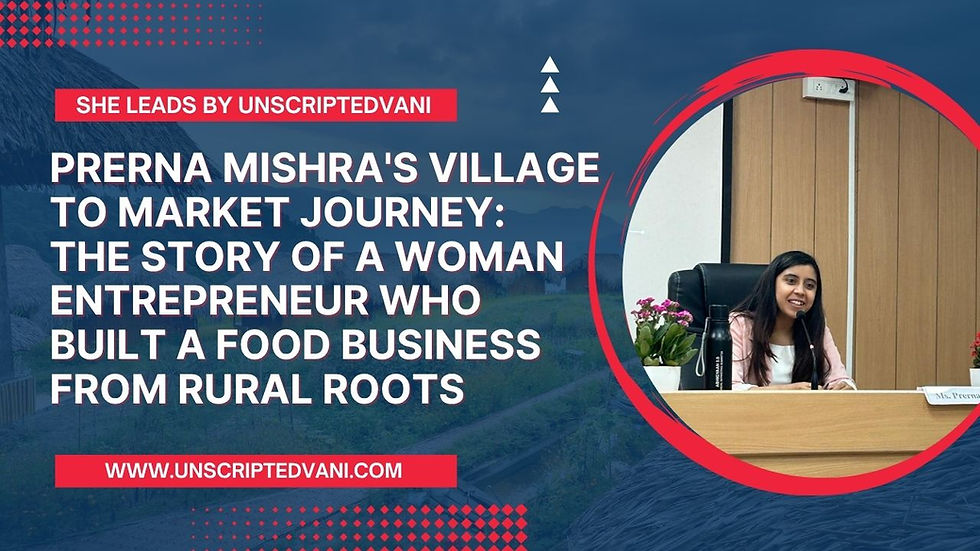
Prerna Mishra's Village to Market Journey: The story a Woman Entrepreneur who Built a Food Business from Rural Roots
- UnscriptedVani

- Jul 24, 2025
- 4 min read
The corner office had everything—prestige, excellent pay, and the kind of exposure most people dream about. As a Senior Category Manager in retail, Prerna Mishra was living the corporate dream, working with big brands, tracking numbers, making decisions that moved markets. Yet somewhere between the endless meetings and store visits, a whisper kept growing louder: Is this really what I want to build my life around?
Village to market isn't just a supply chain concept. Sometimes, it's a personal awakening that changes everything.
When the World Paused, Everything Became Clear
The pandemic of 2020 sent Prerna back to her village in Jharkhand, where something extraordinary happened. After years of building expertise in the corporate world, she began experiencing her grandmother's kitchen with completely new eyes. The roasting, the hand-pounding, the intentional slowness—this wasn't old-fashioned. This was deeply intelligent food business wisdom that had been perfected over generations.
What if the future of food wasn't in factories, but in the hands of women who had been mastering these recipes for centuries?
This woman entrepreneur journey would be different. It wouldn't be another tech unicorn story, but something more radical—a return to roots that could heal both people and communities while creating a sustainable food business.
The Birth of Something Revolutionary
Natureship emerged not as a business plan, but as a piece of Prerna's soul. It brought together her MBA education, her corporate experience analyzing consumer behavior, and the cultural wealth of her homeland. This village to market vision would bridge two worlds: the discipline of big business and the honesty of handmade food passed down through generations.
But here's where every woman entrepreneur story takes an unexpected turn. In a startup ecosystem where women receive less than 3% of venture capital funding, every step forward feels like swimming upstream. Prerna's journey would prove that authentic food business models could thrive without compromising tradition.
Building People Before Profits
The early days were raw and real. No fancy machinery, just skilled hands that had been feeding families for decades. Prerna shaped everything around a village to market philosophy that put dignity first—flexible hours, fair pay, real ownership for the women who would become Natureship's foundation.
Ambika Didi was among the first to join. A divorcee who had survived abuse, she now operates laptops, manages dispatches, and handles orders like a seasoned professional. Watching her transformation became a daily reminder of why this woman entrepreneur path mattered beyond profit margins.
Then came Jitni Didi, who had never stepped outside her home to earn. Today, she trains others with confidence that radiates through every interaction. For Prerna, this wasn't just about building a food business—it was about proving that empowerment and economics could dance together beautifully.
Could dignity and good work actually scale together?
From Village Wisdom to National Recognition
What started as an authentic food business from Jharkhand and Bihar evolved into something much bigger. Woman entrepreneur challenges often center around credibility and resources, but Prerna's approach of honoring traditional knowledge while implementing modern systems created something unprecedented.
When Natureship was featured in Mann ke Baat, it wasn't just validation—it was proof that the village to market model could capture national attention. Being mentored by IIM Ahmedabad added strategic framework to their grassroots wisdom, creating a hybrid approach that honored both worlds.
Studies show that women entrepreneurs are more likely to seek detailed, specific business solutions, and Prerna's story resonates because it addresses the real complexities of building authentic businesses in modern India.
The Michelangelo Moment
Traditional food business tutorials don't prepare you for the hardest truth: you're not just building a company, you're chiselling yourself. Supply chain hurdles in rural areas, resource constraints, the patience required to bring together women who've never collaborated on this scale—these aren't just business challenges for a woman entrepreneur, they're character tests.
Research reveals that female-led businesses face unique obstacles but build stronger community trust through authentic storytelling. Every single day, despite the chaos, feels alive with purpose because what started as potential has become kinetic—moving, growing, transforming lives through the village to market model.
The Revolution Continues
Prerna's food business journey often gets questions about exit strategies or scaling plans. But some woman entrepreneur journeys are different. Some stories are about proving that ancient food wisdom isn't backward—it's timeless. That women in villages aren't weak—they're quietly powerful economic forces waiting for the right platform.
What if the most radical thing you could do in 2025 was to honor what came before while building what comes next?
The village to market philosophy extends beyond Natureship. Food business opportunities in India are expanding rapidly, with traditional and organic approaches gaining significant traction among conscious consumers. Prerna's model proves that combining ancestral knowledge with modern distribution can create sustainable, scalable impact.
Lessons from a Woman Entrepreneur Who Chose Differently
Prerna reflects: "When you build something, one day you realize you aren't building a brand. You are building yourself. Holding space for yourself, chiselling yourself. And one day you wake up to the Michelangelo of your life that you are."
Her village to market approach challenges every assumption about what a successful food business should look like. Instead of replacing tradition with technology, she proved they could amplify each other. Instead of extracting value from rural communities, she demonstrated how to create it.


Comments