_edited.jpg)
Teach For India Alumni Building Rocket Learning for Early Childhood
- UnscriptedVani

- Aug 11, 2025
- 2 min read
This concept of making early years learning fun, accessible, and equitable for children from various socio-economic backgrounds seeks to change the way preschool and early-grade education is imparted, especially in the neglected areas.
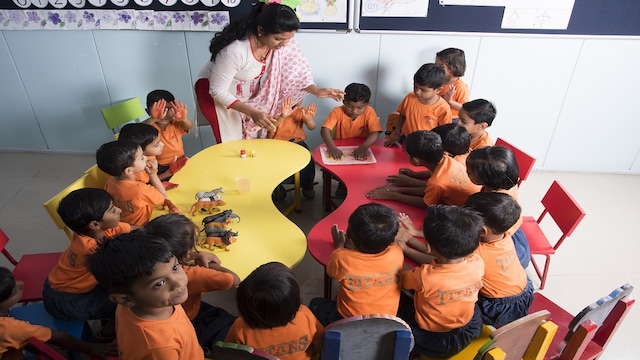
The process began, as a lot of Teach for India alumni believe, with a need to address the challenges in Indian education that are never solved by merely focusing on older children. By the time students reach middle school, the gaps in learning have already set in, due to the often-deficient early childhood education, so to address this impairing factor, Rocket Learning had made early learning fun, accessible, and equitable for children across socio-economic lines.
At the core of Rocket Learning's model is an amalgamation of technology with human bond. The team utilizes simple and inexpensive tools to digitally reach out to parents and caregivers, via WhatsApp, providing small and simple learning activities with guidance to carry them out at home. Thus, imparting knowledge empowers parents and caregivers to play an active role in a child's learning journey, even in instances wherein they do not possess formal educational qualifications. Their work also helps strengthen the crucial link between home and school so that learning becomes a continuous process-aided by multifarious environments.
The program aims to be in sync with India's framework guiding ECE (early childhood care and education) and focuses on key parameters such as language acquisition, numeracy, physical, and socio-emotional development. The content is catered towards active participation, cultural relevance, and adaptability, given regional variations. Teachers and community workers are also being trained to facilitate these learning experiences so that the ecosystem of support for every child becomes robust.
One of Rocket Learning's most telling impacts is its ability to scale without losing the human touch. Integrating community structures already in existence, such as Anganwadi's and primary schools, and marrying this with technology that is accessible; this initiative has impacted hundreds of thousands of children and families. This model will not only maximize impact but will also keep the cost at a level that is sustainable, which is extremely important for education intervention on the long run.
Founded by Teach for India alumni, Rocket Learning comes with a depth of knowledge of India's educational landscape and elements of leadership perfected during their fellowship. This insight enabled them to construct solutions that were truly innovative and practically applicable within such constraints of public education systems. Their work reminds us that any sort of systemic change in education needs to start early, involve communities, and think beyond the classroom.
Rocket Learning is much more than an early childhood education program; it is a movement to ensure that every child in India starts their learning journey with the skills, confidence, and curiosity to thrive. It seeks to build a pathway for educational success by breaking the cycles of educational disadvantage during these formative years. It does so while carrying forth the spirit of Teach for India’s mission, charting a new course toward a brighter, more equitable future for the youngest citizens of India.


Comments